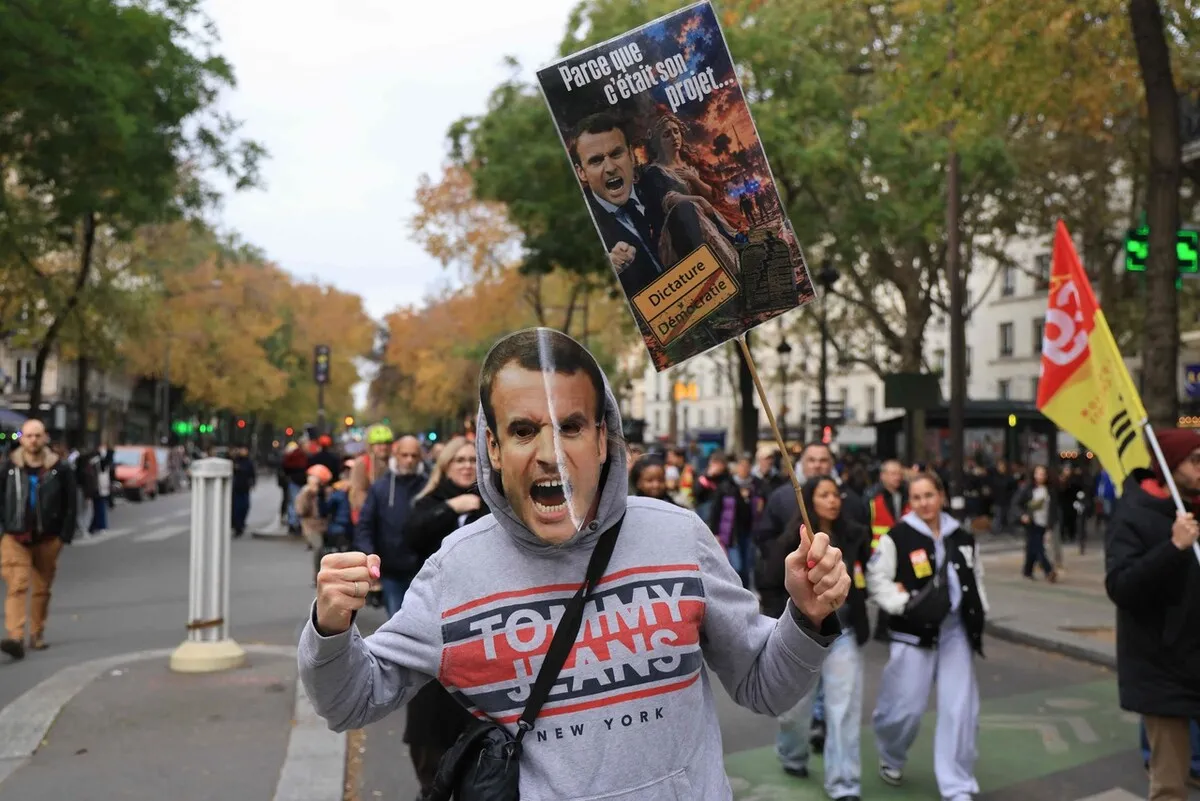
Roughly 576,000 people joined demonstrations across France on Thursday, according to the interior ministry, a weekday turnout that exceeded the three large weekend protests held earlier. Marches took place in Paris, Lyon, Marseille and Nantes, among other cities, with participants voicing anger over high living costs, strained public services and problems in education, 한겨레 reported, citing AP, AFP and Reuters.
The CGT union, which helped organize the action, put the national figure at 1.6 million and described it as the largest mobilization since the 2023 protests against President Emmanuel Macron's pension overhaul. The gap between the two counts is typical of French labor disputes, where unions and the government routinely publish different estimates.
Why it matters
The timing is notable. Weekend demonstrations have drawn crowds in recent weeks, one of them escalating into rioting, but Thursday's turnout was larger than any of them by the ministry's own count. The three earlier weekend rallies were estimated by the government at 550,000, 410,000 and 320,000 people respectively.
A weekday showing of this size suggests the movement has not lost momentum and may be broadening beyond the groups that typically turn out. Teachers and civil servants joined Thursday's action, with about 16 percent of teachers and 9.89 percent of public employees on strike, according to government figures.
Students block schools as public services become the focus
High school students were central to the day. They blocked entrances at schools around the country; the government said 81 of France's 3,700 high schools were shut down, while one student organization said classes stopped at 1,000 schools.
The grievances went well beyond prices. Students and workers said education, health care, rail and postal services were no longer functioning properly and demanded that the government fix them. Medical staff, railway workers and firefighters called for higher pay, better working conditions and more staff and equipment on the ground.
In a joint statement, major unions argued that the cost of medical care, food, rent and gas and electricity was climbing while wages and pensions stayed flat. Martin Thiberge, a grape grower who joined the march in Lyon, told AFP that people wanted to be able to live on what they earn and to receive a wage that allows them to live decently.
Most of the demonstrations were peaceful, but there were clashes. In Paris, some participants at the front of the procession scuffled with police, who fired tear gas; the Paris police said some masked individuals damaged property. Tear gas was also fired in Lyon at protesters dressed in black with faces covered who shouted anti-police slogans. Fires broke out at schools in Paris and Toulouse.
A meeting set for Monday, and an election in the background
Prime Minister Sébastien Lecornu is scheduled to meet unions and employer groups on Nov. 9 to discuss the cost of living and wages.
The marches also drew figures from the political left ahead of the presidential race. Jean-Luc Mélenchon of La France Insoumise, Marine Tondelier of the Greens and Raphaël Glucksmann of Place Publique took part, according to the reports.
Paul Smith, an associate professor of French history and politics at the University of Nottingham in the UK, told AP that French citizens were deeply frustrated with what they see as a government that does not function, and that whoever wins the presidential election will inherit a heavy backlog of problems.
What to watch: whether Monday's talks produce any movement on wages, and whether the unions can sustain weekday mobilization at this scale.